

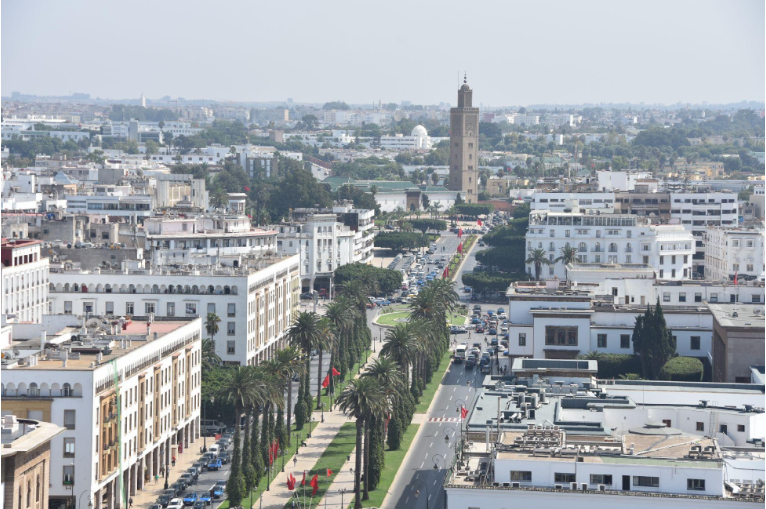
In Rabat, the geography of real estate demand is no longer associated with prestige. In 2025, upscale neighborhoods retained visibility, but demand for both purchases and rentals was largely driven by middle and working-class areas, shaped by income constraints, credit access, and workplace proximity.
Data from real estate platforms, cross-referenced with market price levels, show that residential demand in Rabat has gradually expanded. The average price per square meter in the capital is around MAD 14,500 in 2025, one of the highest levels in the Kingdom, thereby reinforcing households' trade-offs between location, size, and occupancy status. In this context, demand is no longer spread evenly: it is concentrated around several clearly identified hubs, driven by specific economic factors.
Souissi, Hay Riad, and Agdal remain highly sought-after, but these areas alone no longer dominate the market. In terms of volume, most searches are shifting toward neighborhoods offering a better balance between affordability and urban integration.
Both first-time buyers and investors targeting steady rental demand are driving this trend in a city where administrative stability continues to support residential needs.
Fragmented demand reveals household trade-offs
The year 2025 confirms that Rabat now functions as a mosaic of micro-real estate markets. According to reports published by leading advertising platforms, nearly half of national residential demand is for two-bedroom apartments with less than 80 m² of floor space, a profile that largely corresponds to the financial capabilities of the urban middle classes.
In Rabat, this demand structure translates into a high concentration of searches in neighborhoods where budgets remain compatible with prices between MAD 12,000 and MAD 15,000 per square meter.
When it comes to home purchases, tighter financing conditions and cumulative price increases are reducing the number of households able to target premium sectors.
In the rental market, pressure remains high in well-served areas with low vacancy rates, around 5 to 7% in some central neighborhoods, reflecting sustained and continuous demand. This fragmentation illustrates a profound change: solvent demand still exists, but it coexists with a much broader, constrained demand that now structures most of the Rabat market.
Premium neighborhoods: strong, stable demand, but from a minority
Souissi, Hay Riad, and Agdal still account for a significant share of demand in terms of value, but much less so in terms of volume. These neighborhoods mainly attract senior executives, diplomats, senior civil servants, and wealthy investors. Prices here are among the highest in the capital, averaging 23,000 to 25,000 dirhams per square meter in Souissi, around 16,000 dirhams in Hay Riad, and up to 20,000 dirhams in certain areas of Agdal.
At these levels, purchase budgets frequently exceed MAD 1.8 to 3 million for family apartments, which naturally limits the demand base. The market remains active, but highly selective, sensitive to the quality of the property, its precise location, and its standing.
In the rental market, these neighborhoods command high rents, with Hay Riad averaging around 30% higher than Agdal, driven by a high-income clientele seeking comfort and proximity to institutions. These areas now form a specific segment, which is stable but represents a minority compared to the scale of demand elsewhere.
The heart of the market: middle and working-class neighborhoods
Neighborhoods such as Hay El Fath, Nahda, Yacoub El Mansour, Hassan, and L'Océan are now home to the bulk of real estate demand in Rabat in terms of volume. These areas attract working households, first-time buyers, and a large rental population seeking a balance between price, accessibility, and urban centrality. Purchase budgets generally range from MAD 800,000 to MAD 1.5 million, a level more in line with the actual financing capabilities of a large proportion of Rabat households.
Rental demand is particularly strong here, especially in Nahda and Hay El Fath, where rental prices are more moderate and transport links to Hay Riad, the administrative center, and neighboring municipalities are solid. These neighborhoods account for a significant share of rental turnover and transactions, confirming their role as the foundation of the capital's real estate market.
Transitional neighborhoods and suburbs: demand driven by price
Areas such as El Menzeh, Akkari, Aviation-Mabella, and the areas bordering Salé occupy an intermediate position in the demand hierarchy. They attract customers who are excluded from the central neighborhoods but want to remain connected to Rabat.
The price difference plays a decisive role here: in some neighboring municipalities, prices per square meter remain 30 to 40% lower than those observed in the capital, fueling demand based on opportunity and necessity.
Whether for purchase or rental, these areas cater to mid-range budgets, with steady demand but less exposure in the media. They confirm a now well-established reality: in Rabat, real estate demand is no longer concentrated in a few iconic neighborhoods, but is organized according to a clear gradient of price, accessibility, and use, with mid-range and working-class neighborhoods playing a central role.